Language: 日本語版(Japanese version)
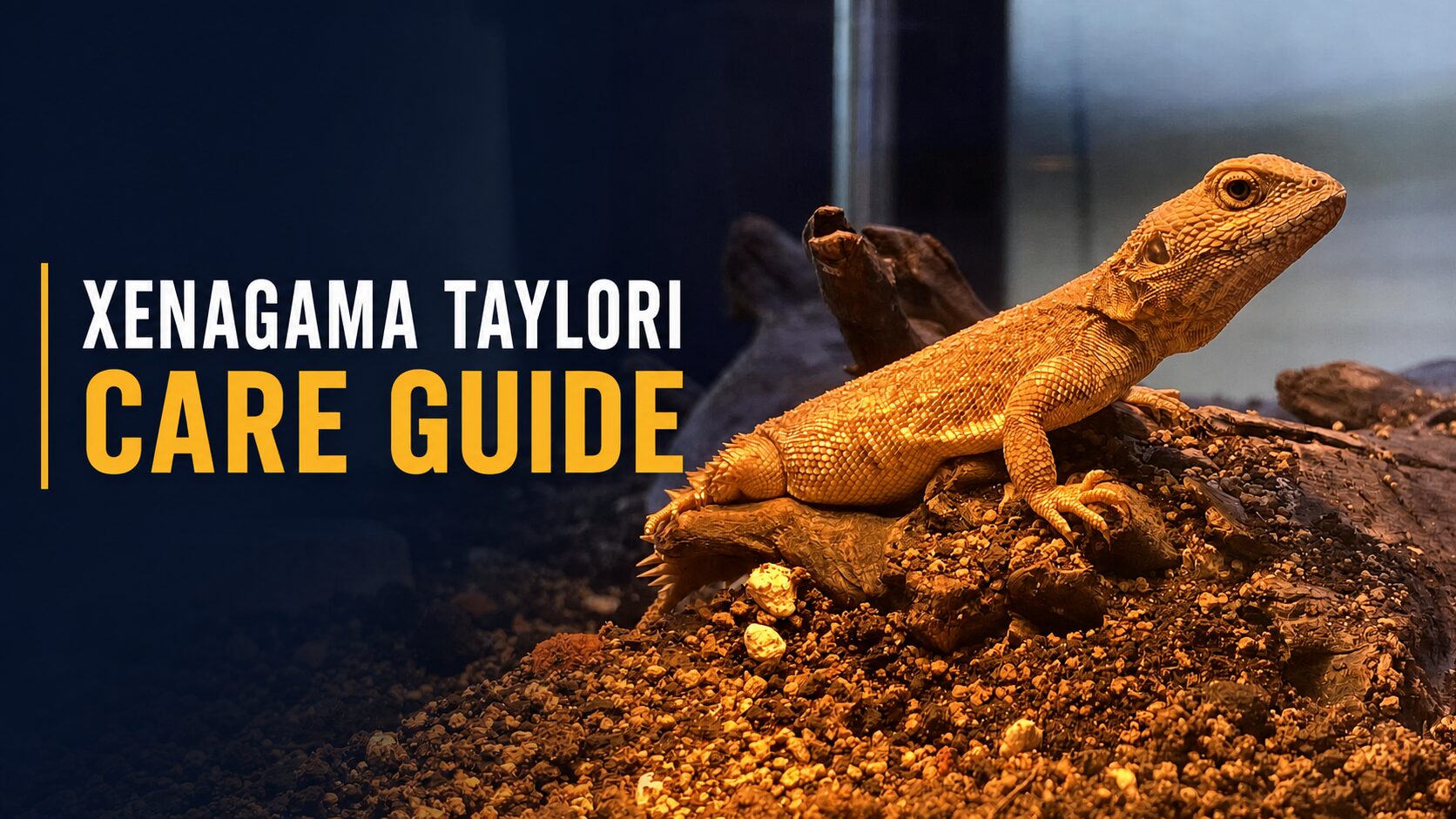
The shield-tailed agama (Xenagama taylori), also called Taylor’s shield-tailed agama or the dwarf shield-tailed agama, is a small agamid lizard from the dry regions of eastern Ethiopia and northwestern Somalia.
I have kept this species for approximately three years and have also bred it in captivity. This guide explains the conditions and methods that I currently use.
The information below is based on my animals and my home in Japan. It should be treated as a firsthand husbandry record rather than the only correct way to keep the species.
Shield-Tailed Agama Care at a Glance
| Item | My current conditions |
|---|---|
| Scientific name | Xenagama taylori |
| Adult size | Approximately 6–8 cm (2.4–3.1 inches) |
| Daytime temperature | Approximately 28–32°C (82–90°F) |
| Basking temperature | Approximately 35°C (95°F) |
| Humidity | Approximately 50–60% |
| Diet | Mainly insects, with some leafy greens and prepared food |
| Activity | Diurnal and ground-dwelling |
| UVB | Required |
| Substrate | A diggable substrate |
| Handling | Best kept to a minimum |
These figures are starting points. The animal’s behaviour, appetite and body condition should always be monitored.
What Makes the Shield-Tailed Agama Unusual?
The most distinctive feature of this species is its short, broad and heavily spined tail.
When threatened, the lizard retreats into a burrow or narrow shelter and positions its tail toward the entrance. The tail acts as a defensive barrier, which is the origin of the common name “shield-tailed agama.”
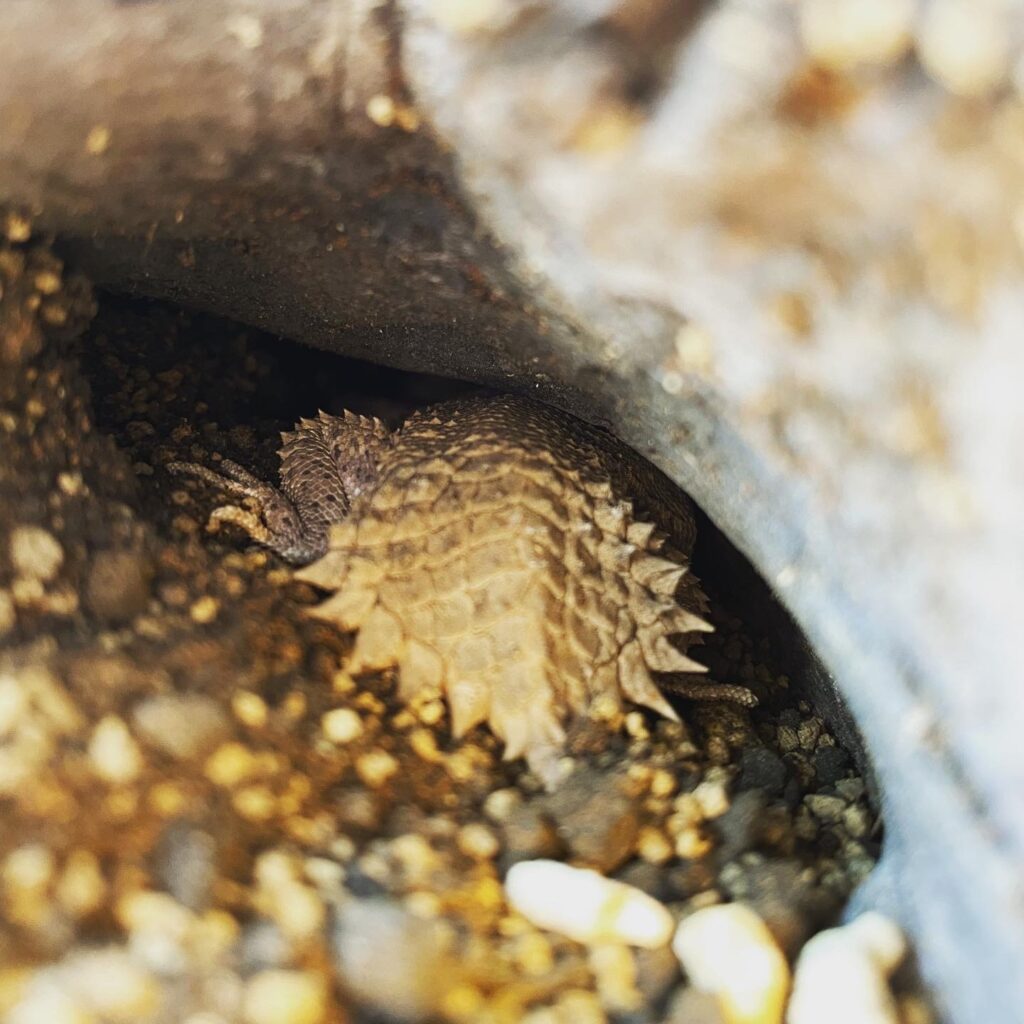
The enclosure should allow this natural hiding behaviour. Flat rocks, cork pieces and other shelters can be used, but heavy objects must be secured so that they cannot collapse when the animal digs underneath them.
Enclosure Size
Although Xenagama taylori is small, it is active and spends much of its time moving across the ground. Floor space is therefore more important than excessive height.
My three adult animals are housed in an enclosure measuring 600 × 450 mm, approximately 23.6 × 17.7 inches.
The adult group consists of:
- One adult female
- Two adult males
This is a description of my current setup, not a general recommendation to house two males together. Multiple males may show territorial behaviour, and separate enclosures should always be available.
My younger male and female are housed individually in separate 300 × 200 mm enclosures, approximately 11.8 × 7.9 inches.
For keepers who are not experienced in monitoring group behaviour, individual housing is the safer option.
Temperature
The general daytime temperature in my enclosures changes slightly with the season but is usually maintained between 28 and 32°C (82–90°F).
I provide a basking area at approximately 35°C (95°F). The rest of the enclosure should be cooler so that the animal can regulate its body temperature by moving between areas.
Temperatures should be measured at the level where the lizard actually sits. I use a thermometer with a probe and check surface temperatures around the basking area.
At night, I allow the enclosure temperature to fall rather than maintaining daytime heat for 24 hours.
I do not use a deliberately controlled winter cooling period. However, the room temperature changes naturally with the Japanese seasons.
Humidity and Ventilation
I generally maintain humidity at approximately 50–60%.
Although this species comes from an arid region, the enclosure does not need to be completely dry at all times. Burrows and the lower layers of substrate may retain more moisture than the exposed surface.
At the same time, constantly wet substrate and poor ventilation should be avoided. I monitor the enclosure for condensation, mould and substrate that remains wet for too long.
A shallow dish of fresh water is provided and cleaned regularly.
UVB and Lighting
As a diurnal agamid, Xenagama taylori requires appropriate UVB exposure.
UVB supports vitamin D3 production and calcium metabolism. This is especially important for growing juveniles and breeding females.
I provide a brightly lit basking area as well as shaded shelters. The lizard must be able to move away from both heat and UVB.
The effective UVB exposure depends on the lamp, distance, mesh and enclosure layout. Lamps should be replaced according to the manufacturer’s guidance even if they still produce visible light.
Substrate and Hides
Digging is an important natural behaviour for this species. I therefore use a substrate that allows the animals to create shallow burrows and sheltered spaces.
The enclosure also contains several hiding places. These allow an animal to move away from the others and rest without being exposed.
Useful features include:
- Secure flat rocks
- Low, narrow shelters
- Cork bark
- Visual barriers
- Open ground
- A basking area
- Shaded retreats
Heavy rocks should not simply be placed on top of deep substrate. They must be positioned securely so that an animal cannot become trapped underneath them.
Diet
Insects form the main part of the diet in my care.
I primarily offer appropriately sized feeder insects such as dubia roaches and crickets. The prey should be small enough for the individual animal, particularly when feeding juveniles.
I also offer leafy greens and sometimes prepared reptile food. Interest in plant-based food varies between individuals.
Feeder insects should be hydrated and gut-loaded, and a varied diet is preferable to relying on a single feeder species.
Calcium and Supplements
I regularly dust feeder insects with calcium powder.
The appropriate supplementation schedule depends on the animal’s age, diet, reproductive condition and UVB exposure. Growing juveniles and gravid females require particularly careful management.
More supplementation is not automatically better. The aim is consistent, appropriate nutrition rather than simply using as much powder as possible.
After experiencing a clutch in which seven developed embryos failed to hatch, I began paying closer attention to the female’s diet, body condition, UVB environment and supplementation. However, I have not confirmed that calcium deficiency caused that failure.
For details, see my case report on seven Xenagama taylori eggs that failed to hatch.
Handling a Shield-Tailed Agama
I keep handling to a minimum.
Some individuals become accustomed to a keeper’s presence and stop hiding whenever someone approaches. This does not necessarily mean that they enjoy being picked up.
I mainly handle the animals for:
- Health checks
- Weighing
- Moving them safely
- Enclosure maintenance
Because this is a very small species, gentle and secure support is important.
Routine Health Checks
I observe the animals daily and regularly record their weight.
I look for:
- Normal activity and basking
- Appetite
- Stable body condition
- Clear eyes
- Normal movement
- Complete shedding around the toes and tail
- Normal droppings
- Signs of chasing or feeding competition
Because Xenagama taylori is small, a change of only a few grams may be significant.
Persistent refusal of food, rapid weight loss, weakness, swollen limbs, breathing difficulty or serious injury should be assessed by a reptile veterinarian.
Group Housing
Animals housed together must all be able to access heat, UVB, food, water and shelter.
Visible fighting is not the only sign of a problem. An animal that remains hidden, cannot use the basking area, consistently eats last or begins losing weight may be experiencing social pressure.
I monitor my adult group closely and keep separate enclosures available. Animals should be separated if compatibility becomes uncertain.
Breeding Experience
I have worked with Xenagama taylori breeding for approximately three years and have successfully hatched approximately 15 babies over the past two years.
My breeding approach focuses on stable husbandry, minimal unnecessary disturbance, monitoring the female’s condition and carefully recording incubation results.
For more detailed information, see:
- Breeding Xenagama taylori: My Three-Year Captive Breeding Record
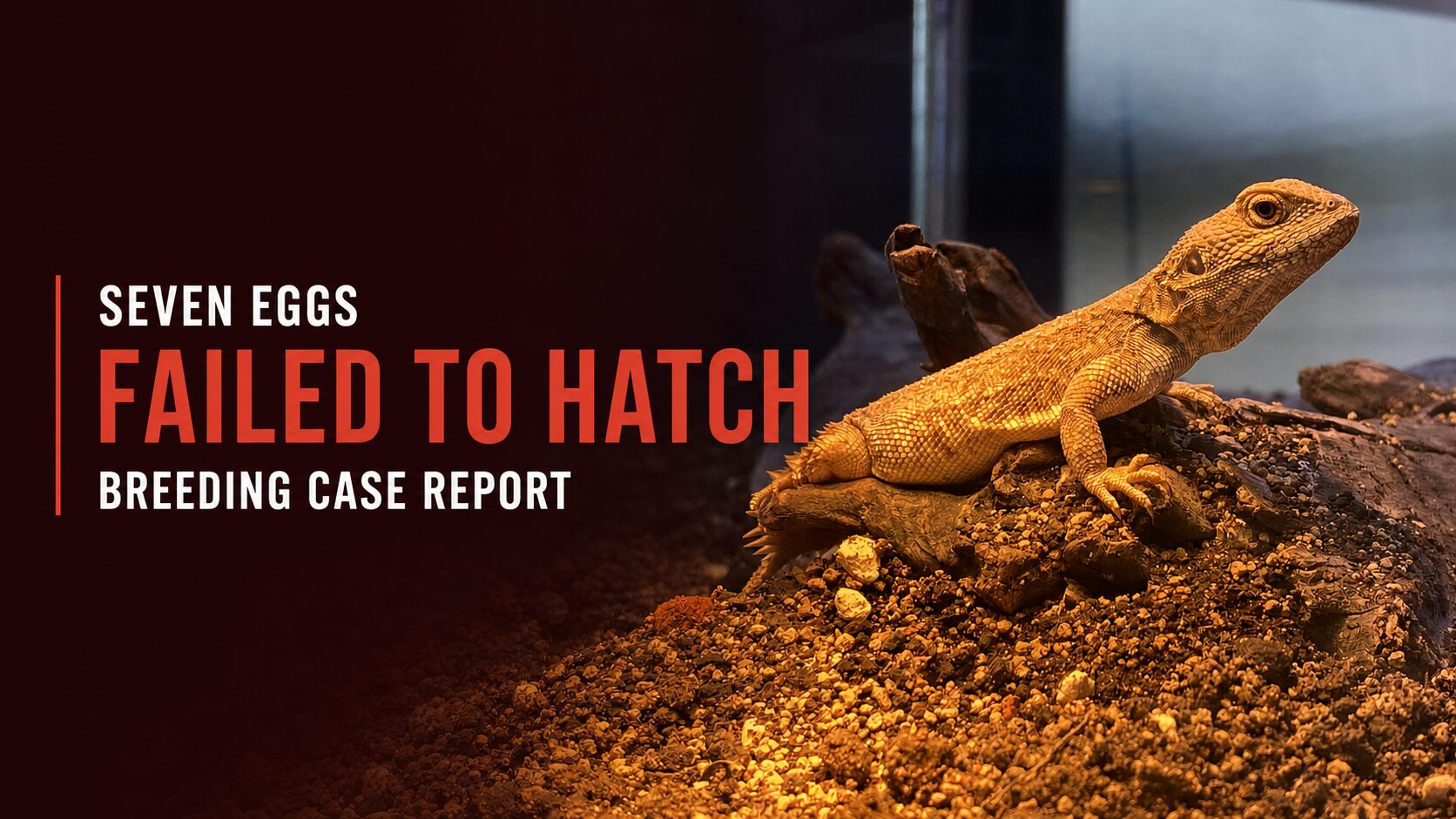
- Seven Fertile Xenagama taylori Eggs Failed to Hatch: A Breeding Case Report
Three Most Important Points
If I had to reduce my husbandry approach to three points, they would be:
- Provide a genuine thermal gradient with heat, UVB and a cooler retreat.
- Offer several secure shelters and opportunities to dig.
- Observe the animals carefully while avoiding unnecessary handling.
Final Thoughts
Xenagama taylori remains uncommon, but I have found it relatively manageable when its basic needs are met.
Its small size, digging behaviour and unusual shield-like tail make it a rewarding species to observe. However, the limited amount of captive information means that keepers should avoid treating any single care guide as definitive.
The conditions described here are based on my own animals. I intend to continue updating this guide as I gain more long-term care and breeding experience.

コメント