Language: 日本語版(Japanese version)
This article documents a failed breeding attempt with the shield-tailed agama (Xenagama taylori), in which seven fertile eggs developed but none of the hatchlings survived.
This is not a successful breeding story. However, detailed captive-breeding information for this species remains limited, and I believe unsuccessful results can be just as valuable as successful ones.
I am publishing this record both for other keepers and as a reference for my own future breeding attempts.
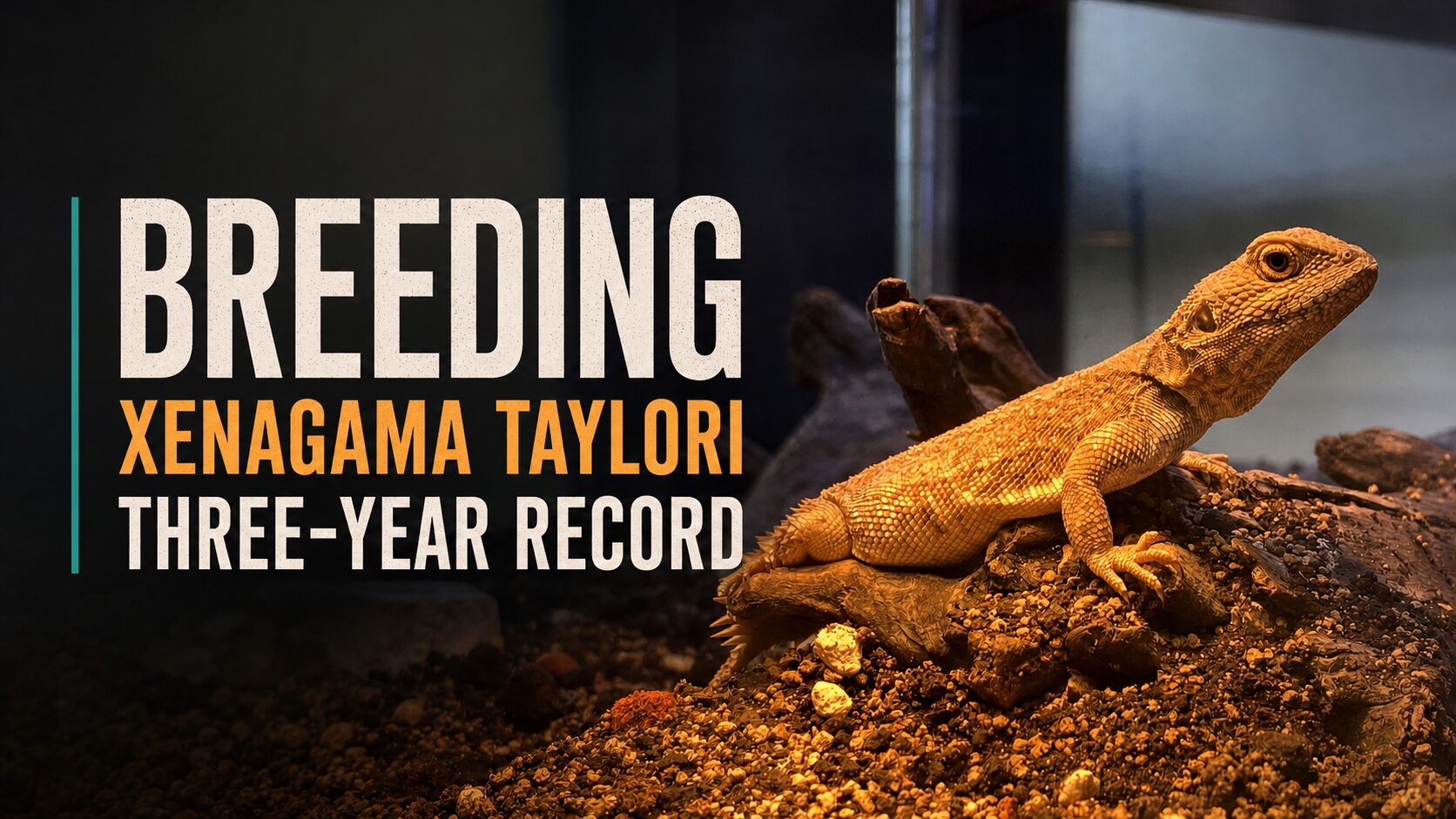
For an overview of my breeding experience, see my three-year Xenagama taylori breeding record.
Why I Am Documenting This Failure
I have been keeping and breeding Xenagama taylori for approximately three years. Over the past two years, I have successfully hatched approximately 15 babies in total.
This clutch produced a very different result. All seven eggs were fertile, and the embryos developed to an advanced stage, but none survived hatching.
The result left me wondering whether I could have acted earlier. I cannot know whether any of the hatchlings could have been saved, but recording the full timeline may help me make better decisions in the future.
It is important to state from the beginning that the cause has not been confirmed. The explanations discussed below are hypotheses based on my observations, not proven conclusions.
Shield-Tailed Agama Incubation Data
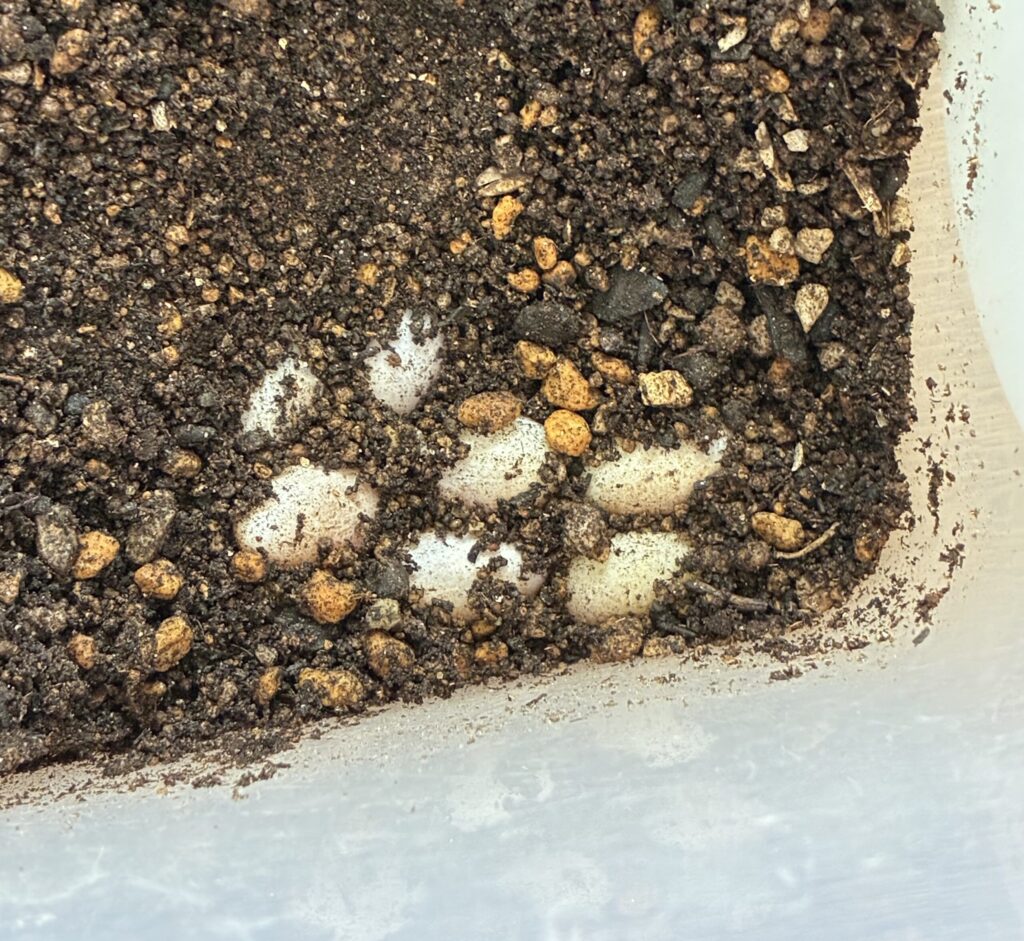
The eggs were managed under the following conditions:
| Item | Details |
|---|---|
| Date laid | May 16, 2026 |
| Number of eggs | Seven |
| Fertility | Embryonic development was confirmed in all seven |
| Incubator | Temperature-controlled chamber |
| Incubation temperature | 30–31°C (86–88°F) |
| Recorded humidity | Approximately 60% |
| First external pipping | July 5, 2026, day 50 |
| Eggs opened for examination | July 8, 2026, day 53 |
| Result | None of the seven hatchlings survived |
Because the eggs were kept in a temperature-controlled chamber, I did not observe any major or sudden temperature changes. However, the absence of an observed fluctuation does not completely exclude temperature or measurement-related problems.
Information About the Female
The female that produced this clutch was born on July 27, 2022. She was therefore approximately three years and ten months old when she laid the eggs.
Her previous breeding history was:
| Item | Details |
| Previous laying experience | She had been laying eggs for approximately two years |
| Estimated total number of eggs previously laid | Approximately 20, including infertile eggs |
| Estimated number of babies previously hatched from her eggs | Approximately 12–13 |
This was not her first clutch, and her eggs had hatched successfully in previous seasons.
That history is one reason I suspect that something about this particular reproductive cycle, incubation period or combination of conditions was different. It does not, however, establish what the difference was.
Timeline of the Failed Hatch
July 5: One Hatchling Pipped the Egg
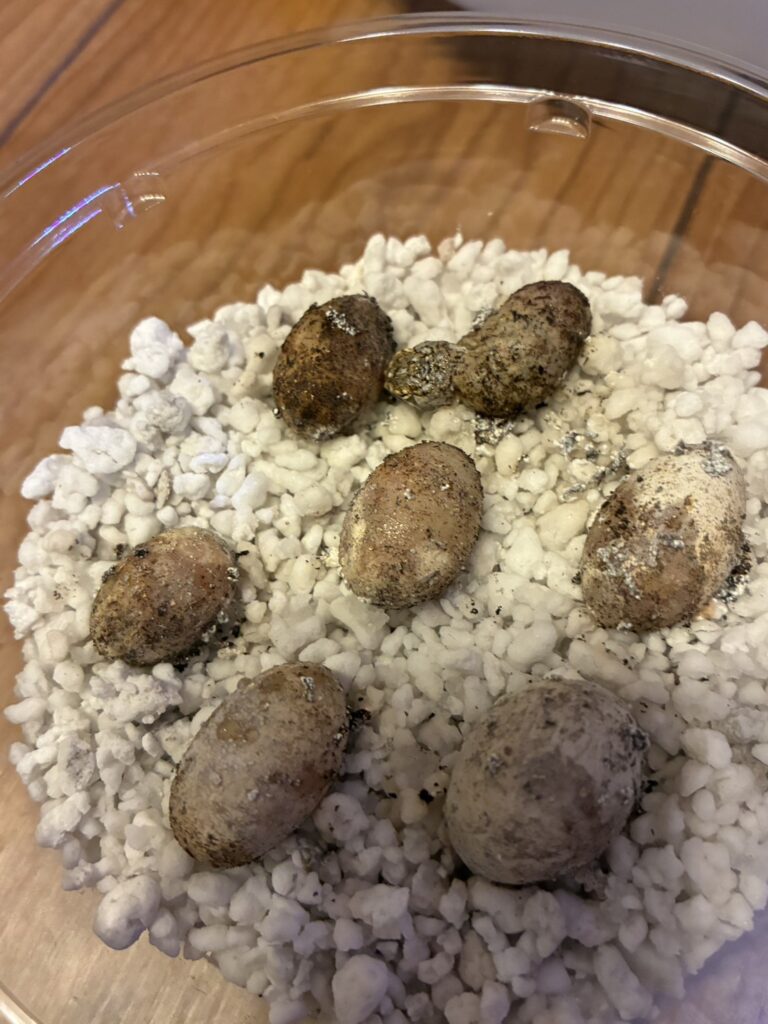
July 5 was day 50 after the eggs were laid.
One hatchling broke through the shell without assistance. However, it was unable to emerge completely and died before leaving the egg.
At that time, two other eggs had become dented and had lost some of their surface sheen. In my previous experience, these changes have sometimes been associated with embryos that have stopped developing or died.
These external changes alone are not definitive proof of death, so I continued observing the remaining eggs.
July 8: I Opened the Eggs on Day 53
My successful Xenagama taylori eggs incubated at approximately 30°C (86°F) have hatched between days 45 and 50. I have not personally had an egg hatch after day 50 under those conditions.
On day 53, I decided to open one egg to examine its condition.
The hatchling inside was already dead. Based on its appearance, I believed it had been dead for at least several days, although I could not determine the precise time of death.
I then examined the remaining eggs because I believed the embryos might also have died or might be unable to emerge. Unfortunately, all the hatchlings were already dead.
What I Confirmed
Several observations can be treated as facts from this breeding attempt:
- Seven eggs showed embryonic development.
- One hatchling pipped its egg on day 50.
- That hatchling failed to emerge completely and died.
- None of the remaining eggs hatched by day 53.
- All seven hatchlings were dead when the eggs were examined.
- The embryos had reached a late stage of development.
- Their yolk sacs appeared to have been absorbed.
The absorbed yolk sacs suggest that development had progressed to a late stage. The embryos did not appear to have died during early development.
However, yolk-sac absorption alone does not prove that every hatchling was completely ready or physically capable of hatching.
What Has Not Been Confirmed
I have not established:
- Why the hatchlings died
- Whether parental nutrition contributed
- Whether calcium availability contributed
- Whether the eggshells or inner membranes were abnormal
- Whether humidity was too low
- Whether the temperature or measuring equipment contributed
- Whether the relatively large clutch affected individual hatchling development
- Whether earlier intervention would have saved any hatchlings
- Whether one factor or a combination of factors caused the failure
The following discussion should therefore be read as a list of possibilities to investigate, not as a diagnosis.
Possible Factor 1: The Female’s Nutritional Condition
My leading concern is that the female’s nutritional or calcium status may not have been optimal during egg development.
I had the impression that the eggshells felt softer and less substantial than those from previous clutches. Xenagama taylori, like many other lizards, lays flexible, parchment-shelled eggs, so softness alone is not necessarily abnormal.
Nevertheless, these eggs appeared less firm than I expected from my previous experience.
If the female’s nutrition was inadequate, it might potentially have affected the eggs, embryos or both. However, I did not perform veterinary testing, blood analysis or laboratory examination of the eggs. I therefore cannot confirm that calcium or another nutrient was deficient.
The female had produced viable offspring previously, which shows that she had been reproductively successful. It does not rule out a temporary difference in body condition during this particular reproductive cycle.
Possible Factor 2: A Larger Clutch Than Usual
This clutch contained seven fertile eggs, which was more than I had previously obtained from this female at one time.
I have considered whether producing a relatively large clutch could have placed greater nutritional demands on her. It is possible that maternal resources were distributed across more eggs than in previous clutches.
This remains speculative. Clutch size alone does not demonstrate that the embryos received inadequate nutrition, and I do not have comparative measurements from earlier eggs.
For future clutches, I plan to record the female’s weight and body condition before breeding, during gravidity and after laying. That should provide more useful evidence than clutch size alone.
Possible Factor 3: Humidity or Moisture Conditions Near Hatching
The recorded humidity was approximately 60%.
I am considering whether the conditions were insufficiently moist during the final stage of incubation. If an egg loses too much moisture, the inner membranes may become more difficult for a hatchling to penetrate.
The fact that one hatchling pipped but failed to emerge made me consider this possibility.
However, ambient relative humidity does not necessarily represent the moisture conditions immediately surrounding or inside each egg. Incubation medium, ventilation, container design and the accuracy and location of the humidity sensor may all affect the actual conditions.
I therefore cannot conclude that 60% humidity caused the deaths. In future attempts, I plan to record the moisture of the incubation medium and changes in egg mass or appearance, rather than relying only on an ambient humidity reading.
Possible Factor 4: Insufficient Strength at Hatching
All seven embryos reached an advanced stage, and one broke through the shell but could not emerge.
This pattern made me wonder whether the hatchlings lacked sufficient strength to complete the hatching process.
If parental nutrition or incubation conditions affected muscle, skeletal or general embryonic development, the hatchlings may have reached the end of incubation without being strong enough to emerge.
Again, this is only a hypothesis. Without veterinary examination or necropsy, I cannot determine whether weakness was actually present or what might have caused it.
Temperature Appears Less Likely, but Is Not Excluded
The chamber was maintained at 30–31°C (86–88°F), and I did not observe a sudden temperature change.
This makes a major temperature fluctuation seem less likely than some other possibilities. Nevertheless, it cannot be ruled out completely.
Potential uncertainties include:
- Differences between the displayed temperature and the temperature at egg level
- Local hot or cool areas inside the chamber
- Short fluctuations that were not recorded
- Inaccuracy or calibration drift in the thermometer
- The possibility that a stable temperature was still not optimal for this clutch
For the next breeding attempt, I plan to use an additional calibrated thermometer at egg level and record minimum and maximum temperatures.
My Greatest Regret: Waiting Until Day 53
The most difficult question is whether I should have intervened earlier.
When the first hatchling pipped on day 50 but failed to emerge, I continued waiting. Looking back, I wonder whether examining the other eggs at that point might have revealed a problem sooner.
It is possible that some hatchlings were already dead. It is also possible that one or more were still alive but unable to emerge.
I cannot know whether assisted hatching would have saved them.
Assisted hatching carries serious risks. Opening an egg too early can cause bleeding, expose an unabsorbed yolk sac, introduce infection or kill a viable embryo that simply needs more time. A fixed number of incubation days is not enough, by itself, to justify opening an egg.
For that reason, I do not recommend automatically opening Xenagama taylori eggs on day 50. Intervention should depend on the individual egg, observed pipping, signs of distress, prior incubation data and, where possible, advice from an experienced reptile veterinarian or breeder.
My lesson is not simply “open the eggs earlier.” It is to increase observation during the expected hatching period and prepare clear criteria for deciding when professional or experienced assistance may be needed.
Changes I Plan to Make
Before the next breeding attempt, I plan to make the following changes.
Record the Female’s Condition
I will record:
- Body weight before pairing
- Weight during gravidity
- Weight after laying
- Appetite
- Supplement schedule
- UVB setup and replacement date
- Access to natural sunlight, when safely possible
This will help me evaluate maternal condition using recorded information rather than memory alone.
Review Calcium and General Nutrition
I will reassess:
- The frequency and amount of calcium supplementation
- Whether calcium with or without vitamin D3 is appropriate for the existing UVB exposure
- The variety and nutritional quality of feeder insects
- Gut-loading practices
- Hydration
- UVB strength and positioning
Supplementation should not be increased without limit. Excessive supplementation can also cause health problems, so the goal is an appropriate and consistent program rather than simply providing more powder.
Record Egg Condition at Laying
For every egg, I plan to document:
- Weight
- Dimensions
- Shell appearance
- Shell firmness
- Surface sheen
- Position in the nest
- Changes during incubation
Photographs taken under the same lighting conditions should make comparison between clutches more reliable.
Improve Incubation Monitoring
I plan to use:
- A second calibrated temperature sensor at egg level
- Minimum and maximum temperature records
- More detailed records of incubation-medium moisture
- Regular photographs
- Individual identification for each egg
Increase Observation Near the Expected Hatch Date
Based on my previous results, I will increase observation from approximately day 45 onward.
I will look for:
- Pipping
- Movement
- Dents or collapse
- Loss of surface sheen
- Fluid leakage
- Odour
- A hatchling that has pipped but made no further progress
These signs will not automatically lead to intervention, but they will prompt closer evaluation.
Establish Criteria for Seeking Help
Before the next clutch reaches the hatching stage, I plan to consult an experienced breeder or reptile veterinarian about when assisted hatching may be appropriate.
Having criteria in advance should help avoid making an emotional decision after a problem has already developed.
Lessons That May Apply to Other Reptile Eggs
Some observations from this case may be useful to keepers of other egg-laying reptiles, but incubation requirements differ between species.
Changes such as denting, loss of sheen, failure to progress after pipping and hatching later than the keeper’s established range can justify closer observation. They do not always prove that an embryo is dead.
Likewise, assisted hatching should not be treated as a routine response to an egg passing an expected date. Opening a viable egg prematurely may be more dangerous than waiting.
Species-specific information and the history of the individual breeding group remain essential.
Final Thoughts
I was unable to hatch any of the seven Xenagama taylori eggs in this clutch.
The embryos developed to a late stage, their yolk sacs appeared to have been absorbed, and one hatchling pipped the shell. Despite this, none survived.
My current hypotheses involve the female’s nutritional condition, the relatively large clutch, moisture conditions near hatching, hatchling strength, incubation variables or a combination of these factors. None has been confirmed.
The most useful outcome of this failure is a clearer plan for collecting better information next time. I will monitor the female’s condition, record each egg individually, improve temperature and moisture measurements and establish more careful criteria for responding to hatching problems.
I am sharing this record because uncommon species need honest records of failure as well as success. If other breeders have experienced late-stage embryonic death in Xenagama taylori, comparing detailed incubation data may help us understand these cases more accurately.
This article is based on my own captive-breeding observations. The possible causes discussed here are hypotheses and should not be treated as veterinary diagnoses or established facts.


コメント